A Little Girl, a Big Spirit: Celebrating National Identity in a Sydney Classroom
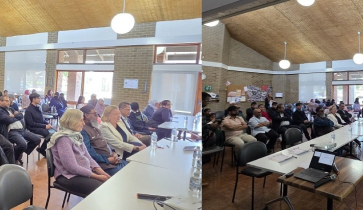
On 4 November 2025, the halls of Alexandria Park Community School glowed with excitement as families, teachers, and students gathered for the annual Night of the Notable Person. Among the displays created by the bright young minds of the Year 5 and Year 6 Opportunity Class (OC) students, one stood out—not for its extravagance, but for the depth of spirit it carried. There, beside a carefully arranged poster, stood Ishika Hafiz, a quiet yet confident Year 5 student whose project radiated the colours, pride, and history of her ancestral homeland: Bangladesh.
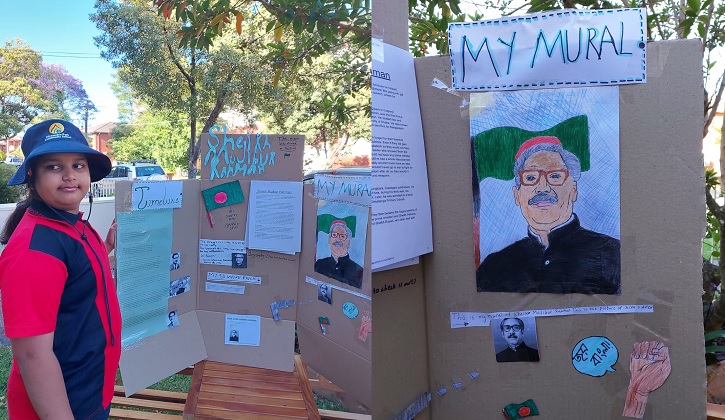
In her corner of the exhibition room—alive with chatter, curious footsteps, and the soft rustle of costumes—stood Ishika’s tribute to Bangabandhu Sheikh Mujibur Rahman, the Founding Father of Bangladesh. Her poster, crafted with meticulous care, shimmered with colour and meaning. A miniature Bangladeshi flag, drawn and shaded by hand, fluttered gently under the indoor lights. A neatly penned timeline traced the arc of a nation’s struggle. Drawings evoked the unmistakable silhouette of Bangabandhu, while Ishika’s own handwritten précis revealed a remarkably mature understanding of his leadership, sacrifices, and unwavering vision for freedom.
For many children of the diaspora, heritage can sometimes feel fragile—held together by stories told at home, festival rituals, or the faint echoes of a mother tongue. Yet Ishika carried her identity not as a distant echo, but as a flame—bright, warm, and alive. In a school where dozens of cultures intersect, her project emerged as a reflection of both pride and belonging. It was not simply a poster; it was a testament to the resilience of memory, the strength of family narratives, and the beauty of multicultural Australia.
Her classmates gathered around her display, their curiosity drawn to the vibrant colours and solemn history it contained. As Ishika explained who Bangabandhu was—his voice of thunder, his courage in the face of oppression, his dream for a free nation—she spoke not as a rehearsing student, but as a young custodian of her culture. It was evident that she had not merely studied the life of a leader; she had embraced it. In her eyes glittered a sense of connection that transcended geography—a bond formed through the values and stories passed down to her at home.
In the multicultural landscape of Sydney, Ishika’s work served as a bridge between worlds. Her display invited her peers to travel momentarily to a distant Bengal—to feel its struggles, admire its heroes, and appreciate the price of freedom. In sharing her heritage, she enriched not only her classroom but also her community, weaving her Bangladeshi identity into the larger Australian tapestry with grace and confidence.
National identity, when expressed through the heart of a child, carries a tenderness that adults often forget. Ishika’s spirit of nationality was not rooted in rigid patriotism; instead, it blossomed as a joyful celebration of where she comes from and the stories she carries. Her pride was gentle yet powerful—an innocent assertion of belonging to two worlds at once. She stood as living proof that identity is not confined within borders; it grows through love, memory, and the courage to share one’s story.
“Amar Sonar Bangla”—My Golden Bengal—seemed to echo softly through her work, as though her poster itself whispered the melody. In that moment, the history of Bangladesh found a home within a Sydney classroom, carried by the hands of a child who believed in remembering where she came from.
As Ishika smiled shyly beside her project board, her parents looked on with hearts full of pride. Teachers admired her depth of research. Classmates marvelled at the history she had brought to life. In that brightly lit school hall, Ishika was more than a Year 5 OC student—she was a young ambassador of her culture, standing tall in the mosaic of Alexandria Park Community School.
Her work reminds us that heritage is not a weight to be carried, but a gift to be shared. Through her poster, Ishika showed how beautifully stories can travel, how boldly identity can shine, and how deeply a child can honour the roots that anchor her. On that November night, she lit up the event—not with grand gestures, but with a quiet, unwavering pride that made everyone pause, smile, and remember the power of where we come from.